Neutropenia is a blood disorder that can affect anyone. Some people are born with it. It can happen after a viral infection. In some cases the cause can be a side effect of a drug, or exposure to certain poisons. People can get neutropenia when treated for cancer with chemotherapy drugs. Sometimes it happens for no known reason.
Saturday, July 12, 2008
NEUTROPENIA
Tuesday, July 8, 2008
CLUSTER HEADACHE
What Causes Cluster Headaches?
The exact cause of cluster headaches is not known. Many experts believe that cluster headaches and migraine headaches have a common cause that begins in the trigeminal nerve, a nerve that carries sensations from the head to the brain and that ends in the blood vessels that surround the brain. Other experts link cluster headaches to the hypothalamus, an area of the brain. Either explanation would account for the periodic nature of the headache.
What Are The Symptoms of Cluster Headaches?
Cluster headaches often occur with the following symptoms:
- Deep, stabbing pain around the temple or the eye
- Stuffy or runny nose
- Tearing and redness in one eye
- Droopy eyelid
How Are Cluster Headaches Treated?
People with cluster headaches usually receive drug therapies. These treatments may be classified as abortive or preventive.
Abortive treatments are directed at stopping or reducing the severity of an attack, and include:
- Inhalation of high-flow, concentrated oxygen
- Injection of Depo-Medrol
- Imitrex injection
- Dihydroergotoamine injection and ergotomine tartrate tablets
- Zomig, Zomig-ZMT, and Zomig nasal spray
- Maxalt, Maxalt-MLT
- Axert
- Deltasone
Preventive treatments are used to reduce the frequency and intensity of cluster headaches and improve the person's quality of life. Preventive drugs include:
- Blood pressure medications, such as beta-blockers and calcium channel blockers
- Antidepressants
- Anticonvulsants
- Periactin
- Nonsteroidal anti-inflammatory drugs (NSAIDs) such as Naprosyn
- Sansert
- Calan, Verelan, Covera-HS
- Eskalith, Lithane, Lithobid, Lithonate, Lithotabs
Surgeries including nerve blocks, ablative neurosurgical procedures and radiosurgery have helped some people with cluster headaches. Nerve blocks involve the injection of pain medicine into or around a nerve or the spine. Ablative neurosurgical procedures are operations that involve the removal or destruction of a part of the brain, the spinal cord, or a nerve. Radiosurgery, a type of surgery that uses radiant energy and does not involve cutting, recently has been used to provide a less invasive alternative for people who have persistent cluster headaches.
Some people with cluster headaches have been helped by alternative or complementary therapies such as chiropractic, acupuncture, osteopathic manipulation, and herbal remedies.
ALZHEIMER'S DISEASE
What is Alzheimer's disease?
Alzheimer's disease (AD) is a slowly progressive disease of the brain that is characterized by impairment of memory and eventually by disturbances in reasoning, planning, language, and perception. Many scientists believe that Alzheimer's disease results from an increase in the production or accumulation of a specific protein (beta-amyloid protein) in the brain that leads to nerve cell death.
The likelihood of having Alzheimer's disease increases substantially after the age of 70 and may affect around 50% of persons over the age of 85. Nonetheless, Alzheimer's disease is not a normal part of aging and is not something that inevitably happens in later life. For example, many people live to over 100 years of age and never develop Alzheimer's disease.
MELANOMA
What is melanoma?
Melanoma is a type of skin cancer. It begins in cells in the skin called melanocytes. To understand melanoma, it is helpful to know about the skin and about melanocytes—what they do, how they grow, and what happens when they become cancerous.
The skin
The skin is the body's largest organ. It protects against heat, sunlight, injury, and infection. It helps regulate body temperature, stores water and fat, and produces vitamin D.
The skin has two main layers: the outer epidermis and the inner dermis.
- The epidermis is mostly made up of flat, scalelike cells called squamous cells. Round cells called basal cells lie under the squamous cells in the epidermis. The lower part of the epidermis also contains melanocytes.
- The dermis contains blood vessels, lymphatic vessels, hair follicles, and glands. Some of these glands produce sweat, which help regulate body temperature. Other glands produce sebum, an oily substance that helps keep the skin from drying out. Sweat and sebum reach the skin's surface through tiny openings called pores.
Melanocytes and moles
Melanocytes produce melanin, the pigment that gives skin its natural color. When skin is exposed to the sun, melanocytes produce more pigment, causing the skin to tan, or darken.
Sometimes, clusters of melanocytes and surrounding tissue form noncancerous growths called moles. (Doctors also call a mole a nevus; the plural is nevi.) Moles are very common. Most people have between 10 and 40 moles. Moles may be pink, tan, brown, or a color that is very close to the person's normal skin tone. People who have dark skin tend to have dark moles. Moles can be flat or raised. They are usually round or oval and smaller than a pencil eraser. They may be present at birth or may appear later on—usually before age 40. They tend to fade away in older people. When moles are surgically removed, they normally do not return.

BOTULISM
What is botulism?
Botulism is a serious illness that causes flaccid paralysis of muscles. It is caused by a neurotoxin, generically called botulinum toxin, that is produced by the bacterium Clostridium botulinum. There are seven distinct neurotoxins (types A-G) that Clostridium botulinum produce, but types A, B, and E (rarely F) are the most common that produce the flaccid paralysis in humans. The other types mainly cause disease in animals. Most Clostridium species produce only one type of neurotoxin.
The recorded history of botulism begins in 1735, when the disease was first associated with German sausage (food-borne disease, or food poisoning after eating sausage). In 1870, a German physician by the name of Muller derived the name botulism from the Latin word for sausage. Clostridium botulinum bacteria were first isolated in 1895, and a neurotoxin that it produces was isolated in 1944 by Dr. Edward Schantz.
How many kinds of botulism are there?
There are three main kinds of botulism, which are categorized by the way in which the disease is acquired:
- Food-borne botulism is caused by eating foods that contain the botulinum neurotoxin.
- Wound botulism is caused by neurotoxin produced from a wound that is infected with the bacteria Clostridium botulinum.
- Infant botulism occurs when an infant consumes the spores of the botulinum bacteria. The bacteria then grow in the intestines and release the neurotoxin.
Three other kinds of botulism have been described but are seen rarely. The first is adult intestinal colonization that is seen in older children and adults with abnormal bowels. Only rarely does intestinal infection with the Clostridium botulinum bacteria occur in adults. Typically, the adult form of this intestinal botulism is related to abdominal surgical procedures. The second kind (injection botulism) is seen in patients injected with inappropriately high amounts of therapeutic neurotoxin (for example, Botox, Dysport), while the third kind (inhalation botulism) has occurred in laboratory personnel who work with the neurotoxins. All of these six kinds of botulism are potentially fatal.
How serious is botulism?
Botulinum neurotoxin is considered one of the most potent, lethal substances known. As little as about one nanogram/kg can be lethal to an individual, and scientists have estimated that about one gram could potentially kill one million people. All forms of botulism can be fatal and are considered medical emergencies. Food-borne botulism can be especially dangerous because many people can be poisoned by eating even small amounts of neurotoxin-contaminated food. A botulism outbreak is a public-health emergency that is reportable to the U.S. government.
How does botulism neurotoxin affect the body?
A neurotoxin actually paralyzes the nerves so that the muscles cannot contract. This happens when the neurotoxin enters nerve cells and eventually interferes with the release of acetylcholine so the nerve cannot stimulate the muscle to contract. Unless the nerve can regenerate a new axon that has no exposure to the neurotoxin, the interference at the neuromuscular junction is permanent. This is why it takes so long to recover from botulism and also why cosmetic and therapeutic uses of diluted neurotoxin can be effective for relatively lengthy time periods.
What kind of organism is Clostridium botulinum?
Clostridium botulinum is the name of bacteria commonly found in soil all over the world. The bacteria are considered to be anaerobic, which means these rod-shaped organisms grow best in low or absent oxygen levels. Clostridium form spores which allow the bacteria to survive in a dormant state until exposed to conditions that can support growth. There are seven types of botulism neurotoxin designated by the letters A through G. Only types A, B, E, and F cause illness in humans.Tuesday, July 1, 2008
MESOTHELIOMA
Mesothelioma is a form of cancer that is almost always caused by previous exposure to asbestos. In this disease, malignant cells develop in the mesothelium, a protective lining that covers most of the body's internal organs. Its most common site is the pleura (outer lining of the lungs and chest cavity), but it may also occur in the peritoneum (the lining of the abdominal cavity) or the pericardium (a sac that surrounds the heart).
Most people who develop mesothelioma have worked on jobs where they inhaled asbestos particles, or they have been exposed to asbestos dust and fibre in other ways, such as by washing the clothes of a family member who worked with asbestos. Unlike lung cancer, there is no association between mesothelioma and smoking.[1] Compensation via asbestos funds or lawsuits is an important issue in mesothelioma (see asbestos and the law).
The symptoms of mesothelioma include shortness of breath due to pleural effusion (fluid between the lung and the chest wall) or chest wall pain, and general symptoms such as weight loss. The diagnosis can be made with chest X-rays and a CT scan, and confirmed with a biopsy (tissue sample) and microscopic examination. A thoracoscopy (inserting a tube with a camera into the chest) can be used to take biopsies. It allows the introduction of substances such as talc to obliterate the pleural space (called pleurodesis), which prevents more fluid from accumulating and pressing on the lung. Despite treatment with chemotherapy, radiation therapy or sometimes surgery, the disease carries a poor prognosis. Research about screening tests for the early detection of mesothelioma is ongoing.
Signs and symptoms
Symptoms of mesothelioma may not appear until 20 to 50 years after exposure to asbestos. Shortness of breath, cough, and pain in the chest due to an accumulation of fluid in the pleural space are often symptoms of pleural mesothelioma.
Symptoms of peritoneal mesothelioma include weight loss and cachexia, abdominal swelling and pain due to ascites (a buildup of fluid in the abdominal cavity). Other symptoms of peritoneal mesothelioma may include bowel obstruction, blood clotting abnormalities, anemia, and fever. If the cancer has spread beyond the mesothelium to other parts of the body, symptoms may include pain, trouble swallowing, or swelling of the neck or face.
These symptoms may be caused by mesothelioma or by other, less serious conditions.
Mesothelioma that affects the pleura can cause these signs and symptoms:
- chest wall pain
- pleural effusion, or fluid surrounding the lung
- shortness of breath
- fatigue or anemia
- wheezing, hoarseness, or cough
- blood in the sputum (fluid) coughed up (hemoptysis)
In severe cases, the person may have many tumor masses. The individual may develop a pneumothorax, or collapse of the lung. The disease may metastasize, or spread, to other parts of the body.
Tumors that affect the abdominal cavity often do not cause symptoms until they are at a late stage. Symptoms include:
- abdominal pain
- ascites, or an abnormal buildup of fluid in the abdomen
- a mass in the abdomen
- problems with bowel function
- weight loss
In severe cases of the disease, the following signs and symptoms may be present:
- blood clots in the veins, which may cause thrombophlebitis
- disseminated intravascular coagulation, a disorder causing severe bleeding in many body organs
- jaundice, or yellowing of the eyes and skin
- low blood sugar level
- pleural effusion
- pulmonary emboli, or blood clots in the arteries of the lungs
- severe ascites
A mesothelioma does not usually spread to the bone, brain, or adrenal glands. Pleural tumors are usually found only on one side of the lungs.
[edit] Diagnosis
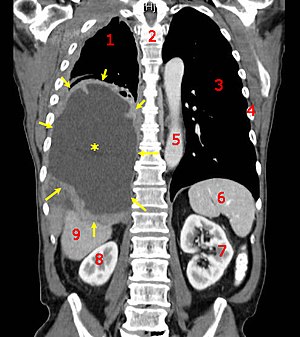
Diagnosing mesothelioma is often difficult, because the symptoms are similar to those of a number of other conditions. Diagnosis begins with a review of the patient's medical history. A history of exposure to asbestos may increase clinical suspicion for mesothelioma. A physical examination is performed, followed by chest X-ray and often lung function tests. The X-ray may reveal pleural thickening commonly seen after asbestos exposure and increases suspicion of mesothelioma. A CT (or CAT) scan or an MRI is usually performed. If a large amount of fluid is present, abnormal cells may be detected by cytology if this fluid is aspirated with a syringe. For pleural fluid this is done by a pleural tap or chest drain, in ascites with an paracentesis or ascitic drain and in a pericardial effusion with pericardiocentesis. While absence of malignant cells on cytology does not completely exclude mesothelioma, it makes it much more unlikely, especially if an alternative diagnosis can be made (e.g. tuberculosis, heart failure).
If cytology is positive or a plaque is regarded as suspicious, a biopsy is needed to confirm a diagnosis of mesothelioma. A doctor removes a sample of tissue for examination under a microscope by a pathologist. A biopsy may be done in different ways, depending on where the abnormal area is located. If the cancer is in the chest, the doctor may perform a thoracoscopy. In this procedure, the doctor makes a small cut through the chest wall and puts a thin, lighted tube called a thoracoscope into the chest between two ribs. Thoracoscopy allows the doctor to look inside the chest and obtain tissue samples.
If the cancer is in the abdomen, the doctor may perform a laparoscopy. To obtain tissue for examination, the doctor makes a small opening in the abdomen and inserts a special instrument into the abdominal cavity. If these procedures do not yield enough tissue, more extensive diagnostic surgery may be necessary.
Risk factors
Working with asbestos is the major risk factor for mesothelioma. Mesothelioma is now known to occur in those who are genetically pre-disposed to it. A history of asbestos exposure exists in almost all cases. However, mesothelioma has been reported in some individuals without any known exposure to asbestos. In rare cases, mesothelioma has also been associated with irradiation, intrapleural thorium dioxide (Thorotrast), and inhalation of other fibrous silicates, such as erionite.
Asbestos is the name of a group of minerals that occur naturally as masses of strong, flexible fibers that can be separated into thin threads and woven. Asbestos has been widely used in many industrial products, including cement, brake linings, roof shingles, flooring products, textiles, and insulation. If tiny asbestos particles float in the air, especially during the manufacturing process, they may be inhaled or swallowed, and can cause serious health problems. In addition to mesothelioma, exposure to asbestos increases the risk of lung cancer, asbestosis (a noncancerous, chronic lung ailment), and other cancers, such as those of the larynx and kidney.
The combination of smoking and asbestos exposure significantly increases a person's risk of developing cancer of the airways (lung cancer, bronchial carcinoma). The Kent brand of cigarettes used asbestos in its filters for the first few years of production in the 1950s and some cases of mesothelioma have resulted. Smoking modern cigarettes does not appear to increase the risk of mesothelioma.
Some studies suggest that simian virus 40 (SV40) may act as a cofactor in the development of mesothelioma.
Treatment
Treatment of malignant mesothelioma using conventional therapies has not proved successful and patients have a median survival time of 6 - 12 months after presentation[citation needed]. The clinical behaviour of the malignancy is affected by several factors including the continuous mesothelial surface of the pleural cavity which favours local metastasis via exfoliated cells, invasion to underlying tissue and other organs within the pleural cavity, and the extremely long latency period between asbestos exposure and development of the disease.
Surgery
Surgery, either by itself or used in combination with pre- and post-operative adjuvant therapies, has proved disappointing. A pleurectomy/decortication is the most common surgery, in which the lining of the chest is removed. Less common is an extrapleural pneumonectomy (EPP), in which the lung, lining of the inside of the chest, the hemi-diaphragm and the pericardium are removed. It is not possible to remove the entire mesothelium without killing the patient.
BRAIN TUMOR
Meningiomas are benign tumors of the meninges that can compress adjacent brain tissue. Symptoms depend on the tumor's location. Diagnosis is by MRI with contrast agent. Treatment may include excision, stereotactic radiosurgery, and sometimes radiation therapy.
Pineal region tumors are usually germ cell tumors (eg, germinoma, choriocarcinoma, yolk-sac tumor, teratoma). Other primary pineal tumors include pineocytoma and the rare malignant pineoblastoma.
Most pituitary tumors are adenomas. Symptoms include headache and endocrinopathies; endocrinopathies result when the tumor produces hormones or destroys hormone-producing tissue. Diagnosis is by MRI. Treatment includes surgery or radiation therapy and correction of any endocrinopathy.
Primary brain lymphomas originate in neural tissue and are usually B-cell tumors. Diagnosis requires neuroimaging and sometimes CSF analysis, Epstein-Barr titers, or brain biopsy. Treatment includes corticosteroids, chemotherapy, and radiation therapy.
Spinal cord tumors may develop within the spinal cord parenchyma, directly destroying tissue, or outside the cord parenchyma, often compressing the cord or nerve roots. Symptoms include progressive back pain and neurologic deficits referable to the spinal cord or spinal nerve roots. Diagnosis is by MRI. Treatment may include corticosteroids, surgical excision, and radiation therapy.
